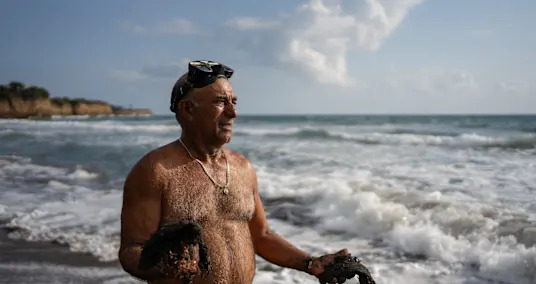
MEXICO CITY (AP) — An oil spill in the Gulf of Mexico in early March spread more than 600 kilometers (373 miles), including to seven nature reserves, and originated from a vessel yet to be identified and two “natural seepages,” Mexican authorities announced Thursday.
Authorities, however, ruled out the possibility of severe environmental damage from the spill off coast of the eastern state of Veracruz.
The release of the preliminary findings came after weeks of controversy surrounding the lack of transparency in the case.
Navy secretary, Admiral Raymundo Morales, said satellite image analysis and inspections of the area identified three sources of the spill: a vessel anchored off the coast of the port city of Coatzacoalcos, in the eastern state of Veracruz; a geological site where crude oil naturally seeps, known as a “chapopotera,” located 8 kilometers (5 miles) from that port; and another natural seepage located in the Bay of Campeche.
Morales said at a press conference that the vessel has not yet been identified because, as of early March, there were 13 ships sailing in the area that had not yet been inspected.
He also admitted that the source of the spill “remains active,” and that one of the main sources is estimated to be the “natural seeps in Cantarell, in the Bay of Campeche.”
“These oil seeps have a constant, natural emission; however, there has been a greater flow of contaminants in the last month,” he said.
Five months earlier, heavy rains and flooding caused a pipeline rupture and a spill, also in Veracruz, that extended for 8 kilometers (5 miles) along the Pantepec River.
In the March spill, Morales reported that the oil covered an area of about 600 kilometers (373 miles) including 200 kilometers (125 miles) of coastline in the southern states of Veracruz and Tabasco. To date, “430 tons of hydrocarbons” have been collected.
Secretary of the Environment Alicia Bárcena reported that the spill affected seven protected natural reserves in the states of Veracruz and Tabasco, but insisted that “we have not detected severe environmental damage.”
Environmental authorities have identified six species, including sea turtles, birds and fish, that were contaminated by the spill.
The National Commission of Natural Protected Areas (Conanp) reported Wednesday in a statement that hydrocarbons have been collected in the Los Tuxtlas Biosphere Reserve, the Veracruz Reef System National Park, the Lechuguillas Sanctuary, the Totonacapan Beaches Sanctuary, the Lobos Tuxpan Reef System Flora and Fauna Protection Area, and south of the Rancho Nuevo Beach Sanctuary in the state of Veracruz. Cleanup efforts were also carried out in the Centla Wetlands Biosphere Reserve in the state of Tabasco.
The international organization Oceana, dedicated to ocean conservation, said this week in a statement that, according to reports from communities belonging to the Gulf of Mexico Reef Corridor Network, the spill killed sea turtles, a manatee and various fish species, and damaged 17 reefs.
___
Follow AP’s Latin America coverage at https://apnews.com/hub/latin-america
LATEST POSTS
- 1
 The most effective method to Amplify Profits from Gold Speculation: Systems and Tips
 - 2Study reveals links between global food systems, obesity, and climate change
- 3UPM Adhesive Materials plans new facility near New Delhi, India
- 4South African army arrive in crime hotspots to help tackle gangs
- 5David Duchovny's new thriller has him stripping down at 65. But its chilling premise hits close to home.





- Pfizer says patient dies after receiving hemophilia drug in trial
- Must-Have Cooking Machine in Your Kitchen
- How Google, Microsoft, Walmart, and other corporate giants are preparing for an aging workforce
- New movies to watch this weekend: See 'Wake Up Dead Man: A Knives Out Mystery' in theaters, rent 'Bugonia,' stream 'Caught Stealing' on Netflix
- Pentagon advances Golden Dome missile defense with new Space Force contracts
- Revvity says it will exceed 2025 profit forecast range
- Many European nations want Israel to cancel 19 new settlement plans
- 6 Natural products High In Vitamins,Which One Do You Like to Eat
- Artemis II astronauts arrive at Florida launch site for first moon trip in 53 years